tuba fingering chart pdf

Tuba fingering charts, often available as a PDF, are essential tools for players of all levels, offering a visual guide to producing specific notes.
These charts detail the precise valve combinations needed on the tuba, streamlining learning and improving performance accuracy, especially when exploring complex passages.
What is a Tuba Fingering Chart?
A tuba fingering chart is a diagrammatic representation illustrating which valves on a tuba need to be pressed to produce a specific pitch. Typically found as a PDF document for easy access and printing, these charts are fundamental resources for tuba players. They visually map the complex relationship between valve combinations and resulting notes, catering to the varying key systems – BB♭, CC, EE♭, and others.
These charts aren’t merely lists; they often include alternate fingerings, crucial for navigating challenging passages or achieving specific tonal qualities. A well-designed PDF chart will clearly label notes, valve positions (often numbered 1-4), and sometimes even octave designations. They serve as a quick reference during practice and performance, helping players instantly recall the correct fingering without hesitation. The availability of PDF versions allows for portability and convenient use on various devices.
Why Use a Fingering Chart?
Utilizing a tuba fingering chart, especially in PDF format, offers numerous benefits. For beginners, it demystifies the instrument, providing a clear roadmap to note production. Even experienced players benefit from quick reference, particularly when encountering unfamiliar passages or alternate fingerings. A PDF chart is readily available on smartphones or tablets, making it accessible during rehearsals or performances.
Fingerings aren’t always intuitive; a chart eliminates guesswork and promotes accuracy. It aids in developing muscle memory, solidifying the connection between valve movements and desired pitches. Furthermore, charts expose players to alternate fingerings, expanding their technical capabilities and allowing for smoother transitions. The convenience of a downloadable PDF ensures a reliable, always-available resource, fostering independent learning and efficient practice sessions.

Understanding the Basics of Tuba Fingerings
Tuba fingering charts, often found as a convenient PDF, illustrate valve combinations; understanding these is crucial for producing correct pitches and navigating the instrument.
The Tuba Key System
Tuba key systems vary, but most modern tubas employ a piston valve system. These valves, controlled by the left and right hands, redirect airflow through different lengths of tubing, altering the instrument’s pitch. A tuba fingering chart PDF visually represents these valve combinations.
Typically, tubas have three to six valves, each corresponding to a specific finger. The first valve generally lowers the pitch by a whole step, the second by a half step, and the third by another whole step. Subsequent valves offer further chromatic possibilities. Understanding this system is fundamental to interpreting any tuba fingering chart PDF effectively.
Different tuba types (BB♭, CC, EE♭) have slightly different key layouts and valve configurations, necessitating specific fingering charts. A comprehensive PDF resource will often include charts for multiple tuba types, catering to a wider range of players and instruments. Mastering the key system unlocks the full potential of the tuba.
Reading a Fingering Chart

A tuba fingering chart PDF typically presents notes in a staff notation or a diagrammatic layout. Each note corresponds to a specific combination of depressed valves, often indicated by numbers (1, 2, 3, 4, etc.) representing each valve. A ‘0’ or an open circle signifies an open tone – no valves pressed.
Charts often differentiate between standard and alternate fingerings. Understanding these variations, detailed within a PDF resource, allows for greater flexibility and smoother transitions. Color-coding or shading can highlight particularly challenging or commonly used fingerings;
When using a tuba fingering chart PDF, always cross-reference the chart with your specific tuba type (BB♭, CC, EE♭) to ensure accuracy. Practice slowly, focusing on clean valve changes and consistent tone production. Regular use of a chart builds muscle memory and improves overall technique.
Common Tuba Ranges and Registers
Tuba fingering chart PDFs often illustrate the instrument’s practical range, typically spanning from approximately E2 to F5, though skilled players can extend this. The range is divided into registers: the fundamental range (low register), the middle register, and the upper register. Charts may visually delineate these sections.
Understanding register shifts is crucial; a PDF chart can indicate fingerings that facilitate smooth transitions between them. Lower registers utilize simpler fingerings, while higher registers often require more complex combinations and embouchure control.
Different tuba types (BB♭, CC, EE♭) possess slightly varying ranges. A comprehensive tuba fingering chart PDF will specify the effective range for each instrument. Mastering these ranges, guided by the chart, unlocks the tuba’s full expressive potential.

Essential Fingering Charts for Different Tubas
Tuba fingering chart PDFs vary by instrument – BB♭, CC, and EE♭ – each requiring unique diagrams due to differing valve configurations and tonal characteristics.
BB♭ Tuba Fingering Chart

BB♭ tuba fingering chart PDFs are incredibly common, as this is a frequently encountered tuba type, particularly in beginner and intermediate settings. These charts typically display a staff with notes and corresponding valve combinations – often represented as 1, 2, 3, or 0 (open).
A comprehensive PDF will cover at least two octaves, showcasing fingerings for the standard playing range. Many charts also include alternate fingerings, useful for smoother transitions or to avoid awkward hand positions. Look for charts that clearly indicate slide positions when applicable, as these significantly impact intonation.
Beginners should focus on mastering the basic fingerings first, while more advanced players can explore the alternate options for greater flexibility. High-quality PDF resources often categorize fingerings by octave and provide visual cues for proper hand placement, aiding in efficient learning and improved technique. Remember to practice slowly and accurately!
CC Tuba Fingering Chart
CC tuba fingering chart PDFs are essential for players utilizing this pitch tuba, commonly favored in professional orchestral and solo settings. These charts, similar to BB♭ versions, visually map notes to valve combinations (1, 2, 3, or 0). However, CC tubas often have a wider range, demanding charts that extend further into the upper register.
A good PDF resource will clearly delineate fingerings across multiple octaves, including those requiring slide adjustments for accurate intonation. Advanced charts may also indicate potential issues with specific fingerings, such as tendencies to be flat or sharp.
Players should prioritize charts that are easy to read and understand, with clear notation and logical organization. Utilizing a PDF allows for easy printing and portability, enabling practice anywhere. Mastering the CC tuba fingering chart is crucial for navigating complex orchestral literature and achieving a professional sound.
EE♭ Tuba Fingering Chart
EE♭ tuba fingering chart PDFs are vital for musicians specializing in British-style brass band music, where this tuba is the standard. These charts differ significantly from BB♭ or CC tubas due to the instrument’s unique valve configuration and transposition. A comprehensive PDF will illustrate the specific fingerings required to produce accurate pitches within the EE♭ tuba’s range.
Players will find that some fingerings are non-traditional compared to other tubas, necessitating dedicated study of the chart. Charts often include alternate fingerings to address intonation challenges or facilitate smoother transitions. The PDF format allows for convenient access during rehearsals and performances.
Look for charts that clearly indicate valve combinations and corresponding notes, and consider those offering guidance on common technical difficulties. Mastering the EE♭ fingering chart is essential for successful brass band performance.
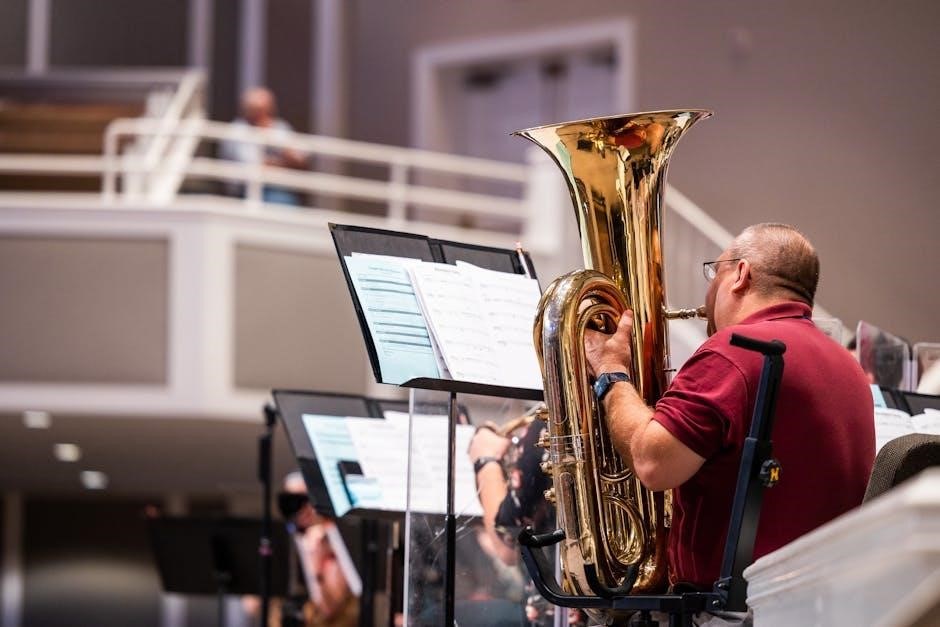
Navigating Complex Fingerings

Tuba fingering chart PDFs often showcase alternate fingerings for tricky passages, aiding in smoother transitions and improved intonation for challenging musical phrases.
Alternate Fingerings
Tuba fingering chart PDFs are invaluable resources when encountering passages demanding swift or nuanced transitions. Often, a single note possesses multiple viable fingerings, and charts meticulously document these alternatives.
These aren’t merely academic curiosities; alternate fingerings can significantly enhance playability, particularly in technically demanding sections. They can minimize hand movement, improve response time, and even subtly alter the tonal color of a note. A comprehensive PDF will illustrate these options, sometimes indicating preferred choices based on context – for example, favoring a fingering that avoids awkward valve combinations during a fast run.
Experienced tuba players rely heavily on this knowledge, instinctively selecting the most efficient fingering for each situation. For students, diligently studying and practicing these alternatives, as presented in a detailed tuba fingering chart PDF, is crucial for developing technical proficiency and musical expression.
Trills and Tremolos
Executing trills and tremolos effectively on the tuba requires not only embouchure control but also a solid understanding of efficient fingerings, often detailed within a tuba fingering chart PDF. These ornaments demand rapid alternation between two notes, and selecting the optimal fingerings is paramount for speed and clarity.
A good PDF resource won’t just show the notes themselves, but may suggest fingerings that minimize hand movement and maximize responsiveness. For instance, utilizing alternate fingerings for one or both notes in the trill can significantly improve execution. Tremolos, similar to trills but faster, benefit from the same principles of efficient fingering.
Mastering these techniques involves studying the chart, practicing slowly, and gradually increasing speed. The tuba fingering chart PDF serves as a roadmap, guiding players toward fluid and articulate ornamentation, enhancing the musicality of their performance.
Glissandos and Slides
Glissandos and slides on the tuba, a dramatic effect, rely heavily on smooth valve transitions, and a comprehensive tuba fingering chart PDF can be invaluable. These techniques involve continuously moving between notes, creating a sliding pitch effect, and understanding the valve sequence is crucial for a clean sound.
A detailed PDF chart will illustrate the precise valve movements needed for various glissando intervals. It’s not simply about knowing the start and end notes, but the intermediate valve positions. Practicing these movements slowly, focusing on evenness and control, is key.
Furthermore, some charts may indicate optimal slide positions for specific instruments, enhancing the smoothness of the effect. Utilizing a tuba fingering chart PDF allows players to visualize and internalize these movements, resulting in expressive and controlled glissandos and slides.

Finding and Utilizing PDF Resources
Tuba fingering chart PDFs are readily available online from music retailers, educational websites, and tuba-specific forums, offering convenient access to essential diagrams.
Where to Download Tuba Fingering Chart PDFs
Numerous online resources offer tuba fingering chart PDFs for free or purchase. Websites dedicated to brass instruments, such as 8notes.com and musictheory.net, frequently host downloadable charts for various tuba types – BB♭, CC, EE♭, and others.
Many university music departments and individual tuba instructors also provide charts on their websites as supplementary learning materials. A quick search on Google or your preferred search engine using keywords like “tuba fingering chart PDF,” “BB♭ tuba fingering chart,” or “CC tuba fingering chart” will yield a wealth of options;
Furthermore, online music stores like Sheet Music Plus and Musicnotes.com sell comprehensive fingering guides, often bundled with other instructional materials. Don’t overlook tuba-focused forums and communities, where members often share helpful PDFs and resources they’ve compiled or discovered.
Benefits of Using a PDF Format
Utilizing a tuba fingering chart in PDF format offers several advantages for musicians. PDFs ensure consistent formatting across different devices – computers, tablets, and smartphones – maintaining readability regardless of the operating system.
They are easily printable, allowing for a physical copy to be kept alongside sheet music during practice or performance. PDFs are also highly portable; a digital chart can be accessed anywhere with an internet connection or stored offline for convenience.
Furthermore, PDFs are generally secure and prevent accidental modifications to the crucial fingering information. The format’s universal compatibility and preservation of visual layout make it an ideal choice for distributing and accessing tuba fingering charts efficiently.
Printing and Accessibility of PDF Charts
Tuba fingering chart PDFs are designed for easy printing, typically fitting standard letter or A4 paper sizes. High-resolution PDFs maintain clarity even when reduced or enlarged during printing, ensuring legibility for all musicians. Accessibility features within PDF readers, such as zoom functionality, benefit players with visual impairments.
Many PDF viewers also support text selection, enabling users to copy and paste specific fingerings for quick reference. Digital charts can be annotated with personal notes or highlights using PDF editing tools.
Storing PDF fingerings digitally allows for quick searching and retrieval, while printed copies offer a tactile experience during practice sessions, enhancing learning and memorization.

Advanced Fingering Techniques
Tuba fingering chart PDFs often include techniques beyond basic notes, like alternate fingerings for smoother transitions and extended ranges for skilled players.
Extended Range Fingerings
Tuba fingering chart PDFs frequently dedicate sections to extended range fingerings, crucial for accessing notes beyond the instrument’s standard capabilities. These techniques often involve complex valve combinations, half-valving, and subtle embouchure adjustments.
Many charts visually demonstrate these fingerings, showing which valves to depress partially or in unconventional sequences. Mastering these requires diligent practice and a keen ear, as intonation can be challenging in the extreme registers.
PDF resources often categorize extended range fingerings by tuba type (BB♭, CC, EE♭), acknowledging that optimal fingerings vary between instruments. Experienced players utilize these charts to navigate demanding repertoire and unlock the full potential of their tuba, pushing the boundaries of the instrument’s sonic landscape.
Harmonic Fingerings
Tuba fingering chart PDFs often include harmonic fingerings, which allow players to produce notes outside the instrument’s normal range by manipulating the airflow and utilizing specific valve combinations. These techniques rely on overblowing and creating harmonic series above the fundamental pitch.
Charts typically illustrate these fingerings with clear diagrams, indicating which valves to engage while adjusting embouchure and air support. Successfully executing harmonic fingerings demands precise control and a strong understanding of the tuba’s acoustics.
PDF resources may categorize harmonic fingerings by the resulting pitch or the valve combination used. Mastering these techniques expands the tuba’s expressive capabilities and enables players to tackle challenging musical passages requiring extended range and unique tonal colors.
Muting Techniques and Fingerings
Tuba fingering chart PDFs sometimes incorporate guidance on muting techniques, as different mutes significantly alter the instrument’s timbre and require subtle fingering adjustments. Charts may illustrate how specific mutes affect intonation across various registers.
Straight mutes, cup mutes, and harmon mutes each demand unique embouchure and valve control to maintain accurate pitch and tonal quality. PDF resources often provide fingering suggestions for compensating for intonation changes caused by muting.
Understanding the interplay between muting and fingering is crucial for achieving desired expressive effects. Charts can demonstrate how to modify fingerings slightly when using a mute to maintain consistent pitch and blend within an ensemble, enhancing overall musicality.

Resources for Further Learning
Tuba fingering chart PDFs are a starting point; explore online lessons, method books, and vibrant tuba forums for deeper understanding and skill development.
Online Tuba Lessons and Tutorials
Online platforms offer a wealth of resources to supplement your tuba fingering chart PDF study. Many professional tuba players provide individualized lessons via video conferencing, offering personalized feedback on technique and addressing specific challenges.
YouTube is brimming with free tutorials covering everything from basic fingerings to advanced techniques. Search for “tuba fingering tutorial” or specific pieces you’re learning to find helpful demonstrations. Websites like Lessonface and TakeLessons connect students with qualified tuba instructors.
These resources often visually demonstrate how fingerings translate to sound, reinforcing what you learn from a PDF chart. Look for instructors who emphasize proper embouchure and breath control alongside fingering accuracy, as these elements are crucial for tone production and overall musicality. Consider supplementing with interactive apps that quiz you on fingerings.
Tuba Method Books with Fingerings
Traditional tuba method books remain invaluable resources, often including comprehensive fingering charts alongside progressive exercises. These books systematically build technique, and the integrated fingerings provide context for learning. Popular choices include the Arban’s Complete Conservatory Method for Trombone and Tuba, though adapted for lower instruments, and the Rubank Elementary Method – Tuba or Sousaphone.
Many method books now offer supplemental PDF downloads containing additional fingerings or exercises. Look for editions that clearly illustrate valve combinations and offer guidance on alternate fingerings. These books often present fingerings within musical phrases, aiding comprehension and application.
Combining a physical method book with a readily accessible fingering chart PDF provides a robust learning experience, blending structured instruction with quick reference materials.
Tuba Forums and Communities
Online tuba forums and communities are excellent platforms for sharing and accessing resources, including fingering charts in PDF format. Players frequently upload and discuss various charts tailored to different tuba types and playing styles. Websites like Tubenet and the International Tuba and Euphonium Association (ITEA) host active forums.
These communities allow you to ask specific questions about challenging fingerings, receive advice from experienced players, and discover lesser-known alternate fingerings. Members often share customized PDF charts they’ve created or adapted.
Participating in these forums provides a collaborative learning environment, supplementing traditional resources and offering practical solutions to fingering challenges. It’s a great way to expand your knowledge and find specialized PDF resources.